Why New York City Has Become One of America's Best Americana Music Scenes
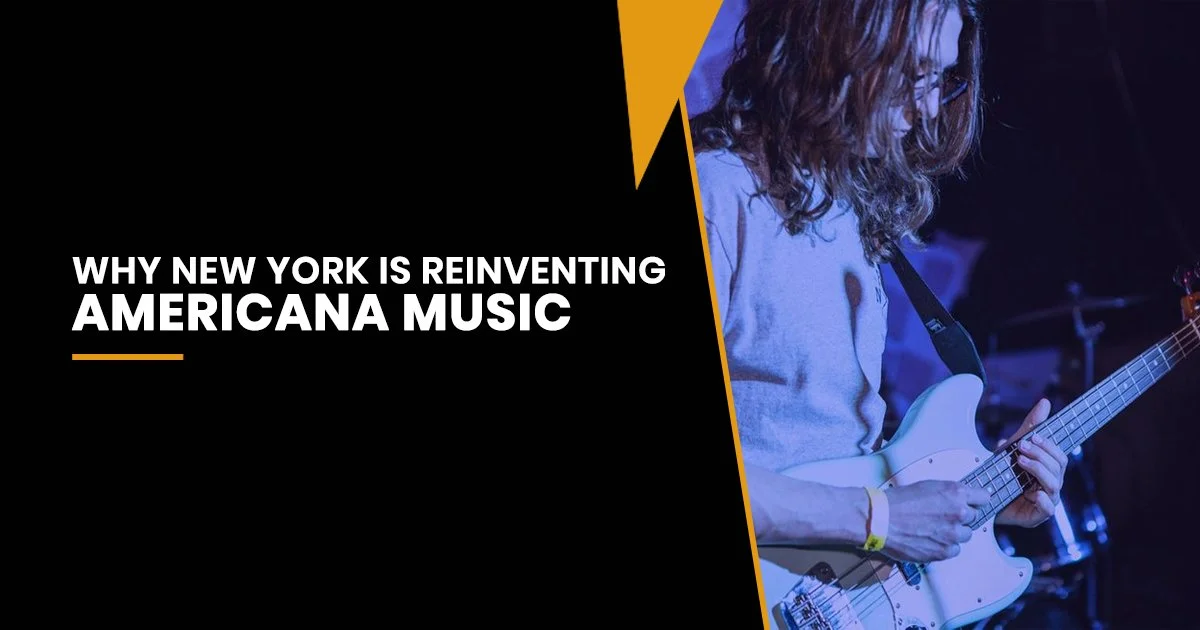
The genre has a mythology.
Porches. Dirt roads. The kind of stillness where you hear yourself think. Robert Johnson at a Mississippi crossroads. Woody Guthrie on the flatlands of Oklahoma. The Carter Family in a Bristol, Tennessee recording studio in 1927. Americana's origin story is insistently rural, insistently Southern, insistently rooted in places where the quiet runs deep and the land runs wide.
New York City is none of those things.
It is, by almost every measure, the opposite. It is dense, loud, relentlessly urban, and constitutionally incapable of the kind of stillness that produced the music's founding mythology. And yet — New York City is producing some of the most vital, emotionally honest, genre-pushing Americana music being made right now.
Understanding why that tension produces great music, rather than just contradiction, is one of the more interesting things happening in American roots music in 2026.
Why Does New York City Have an Americana Music Scene at All?
New York City has an Americana scene because the genre's core qualities — storytelling rooted in real experience, emotional honesty over commercial polish, music built around what it actually costs to be human — translate to urban experience as naturally as they ever did to rural experience, and New York produces those raw materials in abundance.
The misreading is thinking Americana is about geography. It isn't. It's about orientation.
An Americana song isn't a song about the South or the countryside. It's a song that takes its emotional life seriously enough to write it down without flinching. That can happen in a hollow in Appalachia. It can happen in a Brooklyn apartment at 2am when something is sitting on your chest and you need to figure out what it is before you can sleep.
The city generates the same raw material the genre has always worked with — love, loss, the gap between what you hoped for and what arrived, the specific exhaustion of caring about something for a long time. What changes is the pace and the texture. New York puts those experiences under pressure. The city doesn't give you time to romanticize them. You get the thing as it actually is, not filtered through distance and nostalgia.
Which means when a New York Americana artist writes about those experiences, the songs carry a different quality of urgency. Not better than the Southern tradition. Different. Faster. Harder-edged. Less willing to wait for resolution.
Which New York City Venues and Spaces Are Central to the NYC Americana Scene?
The New York City venues most central to the Americana scene are small rooms — Rockwood Music Hall on the Lower East Side, the Jalopy Theatre in Red Hook, and a rotating constellation of listening bars and club stages — where the combination of city audiences and intimate scale produces the specific quality of attention that Americana performance requires.
This is worth being specific about because the venues shape the music.
Rockwood Music Hall operates on a model uniquely suited to what Americana requires — multiple small stages running simultaneously, tight sets, audiences that came to listen rather than be seen, a room where the conversation stops when something is actually happening on stage. It has become one of the de facto homes of NYC Americana precisely because its physical structure demands the quality of attention the genre rewards.
The Jalopy Theatre in Red Hook is the genre's more explicitly rootsy outpost — a venue that stocks vintage instruments, hosts instrument repair workshops, runs shape-note singing sessions, and books bills that range from old-time string bands to contemporary songwriters who've absorbed that tradition and pushed it somewhere new. It's where the genre's historical consciousness and its living present are in the same room at the same time.
Beyond specific venues, the NYC Americana scene runs substantially through the apartment-concert and house-show circuit — shows in living rooms and lofts where the artist and audience are close enough that there's nowhere for the performance to hide. These are the spaces where careers get built before they reach the stage that gets written about.
As we explored in why the best Americana shows in NYC happen in rooms you've never heard of, the relationship between venue scale and music quality in this genre isn't accidental — it's structural.
Who Are the New York City Americana Artists Defining the Scene in 2026?
The New York Americana artists defining the scene in 2026 are a generation of musicians who absorbed the genre's roots tradition through deliberate study rather than geographic inheritance, and are using that foundation to build music that sounds unmistakably contemporary while remaining committed to the storytelling and emotional honesty the genre demands.
The scene doesn't have one sound. It has a set of shared values applied in different directions.
There are artists working in relatively traditional formats — acoustic guitar, close harmonies, songs structured like short stories — who bring a city-informed psychological sharpness to forms that have existed for a century. There are artists whose instrumentation is more electric and whose production owes something to indie rock, but whose commitment to lyrical honesty and narrative specificity is entirely Americana. There are songwriters who are clearly in conversation with the genre's canonical figures — the Townes Van Zandts, the Gillian Welches, the John Prines — and using that conversation as a foundation to say something the tradition hasn't said yet.
What unites them is less a sound than an approach. They're writing from the inside of their actual experience, in a city that makes that experience specific and pressurized, and they're not softening the edges for accessibility. The result is music that sounds like where it was actually made — which is what Americana has always asked for, regardless of the geography.
The Wonder Licks exist within this scene. We came to it from a particular direction — classical piano training, Nashville's Belmont University, psych-rock, the literary tradition — and the music we make reflects those accumulated influences working on each other. That's the process the genre has always depended on: different roots creating unexpected combinations.
You can hear what that sounds like on our original music page.
How Does Playing Americana in New York City Change the Music Itself?
Playing Americana in New York City changes the music by removing the pastoral buffer — the sense that difficulty can be survived by returning to something simpler and more rooted — and replacing it with the city's particular quality of forward pressure, which produces songs that tend toward urgency and complexity rather than resolution and comfort.
The Southern and rural Americana tradition has always had the land underneath it as a kind of emotional resource. When things fall apart in a Townes Van Zandt song, there's still the sense that the earth is real and permanent and the human drama plays out against something vast and indifferent but also somehow stabilizing.
New York doesn't offer that. The city is entirely human-made, entirely contingent, and constantly changing. There's no stable natural backdrop against which to measure the drama. Which means the drama is everything — there's nothing else to fall back on.
New York Americana songs tend to be less resolved. The story ends before the answer arrives. The narrator is still in the middle of the thing rather than looking back at it from a distance. That's not a deficiency — it's what the city produces in its artists. The music sounds like where it was made.
This is part of what we mean when we describe our sound as futuristic Americana. Not a rejection of the tradition, but a continuation of it into a different landscape — where the roots are intact and the environment is radically different, and the music has to hold both of those things simultaneously.
What Can Someone New to Americana Learn From the NYC Scene That They Wouldn't Learn Anywhere Else?
Someone new to Americana who engages with the NYC scene learns that the genre is not primarily about place of origin — it's about a quality of attention to human experience — which opens the music's entire history in a new way and makes the Southern and rural roots feel like the beginning of an ongoing conversation rather than a fixed tradition.
This is the gift the city gives to the genre.
When you encounter Americana through its New York iteration — through artists who came to the tradition from the outside and chose it deliberately, rather than inheriting it by birth — you understand something about why it matters that might not be as visible when it's simply the music of the place you grew up.
You understand that the genre's great artists chose their influences and their commitments. Gillian Welch grew up in Los Angeles. She chose to make the music she makes. That choice is what makes it meaningful — not geography, not inheritance, not proximity to the culture's origins.
The NYC scene makes that visible at every show. Every artist there came from somewhere else or chose this music when other options were available. That voluntary commitment to rootsy, honest, emotionally demanding music — in a city that offers every possible alternative — is itself a kind of statement about what the genre is worth.
If you're new to Americana and want to understand what it's actually about underneath the surface — not the aesthetic but the animating purpose — the New York scene is one of the best places to find that out. Start with the Top 100 Americana songs we've compiled to build your foundation — then come find us live and hear what those roots sound like growing in different soil.
FAQ
Is there a specific Americana music festival in New York City worth attending?
New York doesn't have a dedicated Americana festival on the scale of Americanafest in Nashville or Hardly Strictly Bluegrass in San Francisco, but several events function similarly — Newport Folk Festival in Rhode Island is the Northeast's most significant roots music gathering and draws heavily from the NYC scene. Within the city, Rockwood Music Hall periodically programs Americana-focused showcase nights, and the Jalopy Theatre runs ongoing programming across the year.
How did New York City develop an Americana scene when the genre is so associated with Southern and rural America?
The scene developed primarily through migration — musicians who grew up elsewhere and moved to New York, bringing their musical roots with them — and through deliberate artistic choice by city-raised musicians who found the genre's values more aligned with what they wanted to say than anything else available. New York has always absorbed and transformed cultural traditions from elsewhere. Americana is one of the more recent examples.
What makes a New York Americana show different from an Americana show in Nashville or Austin?
The audience composition and the room scale are the most immediate differences. New York Americana shows tend to happen in smaller rooms with audiences that are more musically eclectic — people who might also attend jazz, indie rock, or classical performances. The cross-genre fluency of New York audiences pushes artists to be more adventurous at the edges of the genre, knowing the room can follow them there.
Where should someone start if they want to explore New York City Americana music?
Rockwood Music Hall's calendar is the most reliable entry point — multiple shows most nights, free or low cover, and a booking aesthetic that favors original artists over tribute acts. The Jalopy Theatre's schedule is worth checking for more roots-focused programming. Following local music media like Brooklyn Vegan and the New York Times arts calendar surfaces Americana shows regularly.
Do The Wonder Licks play regularly in New York City?
Yes. New York is our home and the primary market where we perform. Check our tour page for current show dates — we update it as bookings are confirmed.
Is the New York Americana scene growing or contracting in 2026?
Growing, by most indicators. The combination of rising streaming accessibility for independent artists, the continued strength of small venue culture in New York, and the genre's broader national momentum has sustained and expanded the NYC scene. Several artists who built their careers in New York Americana rooms have moved into national touring over the past few years, which has raised the scene's profile and attracted new artists.
How does the NYC Americana scene connect to the broader national Americana community?
Strongly — through Americanafest showcases where New York artists perform for national industry audiences, through booking relationships that extend along the northeast touring corridor and nationally, and through the increasingly interconnected streaming and social media ecosystem that makes geographic boundaries less definitive than they were a decade ago. New York artists are present in national Americana conversation in a way that wasn't true twenty years ago.
What is The Wonder Licks' relationship to the New York Americana scene?
We're part of it — actively performing, connected to other artists in the community, and making music that reflects both the tradition's roots and the city's specific influence on how we hear and write. Our sound is what happens when those two things work on each other long enough to produce something neither would have created alone.
The tradition is Southern. The artists are from everywhere.
That tension is where some of the best music is being made right now.